
Welcome to the Mathematical World!
Bhaskara I
Bhaskara I (c. 600 – c. 680 CE)
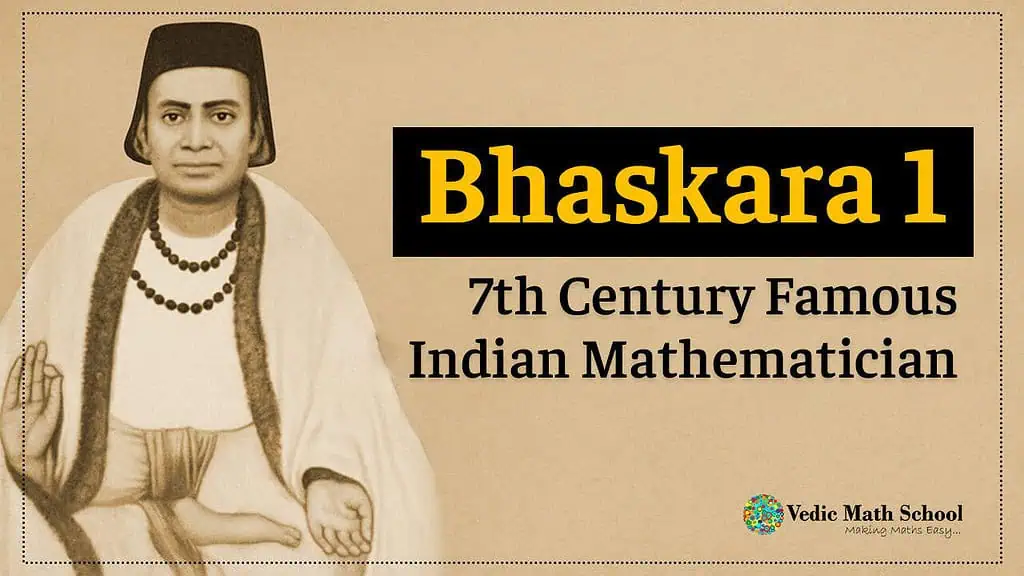
Bhaskara I was one of the earliest Indian mathematicians to give a systematic exposition of Aryabhata’s work. Born in the 7th century in what is now modern-day Karnataka, Bhaskara I belonged to the school of Aryabhata and was a devout follower and commentator of Aryabhata's astronomical and mathematical principles. He made profound contributions to trigonometry, astronomy, and mathematical interpretation.
Major Works
- Mahābhāskarīya
- Laghubhāskarīya
- Āryabhaṭīyabhāṣya — a commentary on Aryabhata’s Aryabhatiya
These texts provided not only clarification of Aryabhata's concepts but also introduced innovations and computational methods that would influence subsequent generations.
Mathematical Contributions
- Sine Approximation Formula
-
Bhaskara I developed a highly accurate sine approximation formula:
This formula, given in the Mahabhaskariya, approximates the sine function with surprising precision and demonstrates Bhaskara's deep understanding of trigonometric properties. - Number Theory and Zero
- Although he adopted Aryabhata’s use of zero as a placeholder, Bhaskara I clarified its operational rules and distinguished between valid and undefined expressions, rejecting illogical operations like division by zero.
- Algebra and Arithmetic
- He explored arithmetic operations, ratios, and equations. His clarity and consistency in explaining mathematical processes laid a foundation for future advancements.
Astronomical Contributions
Bhaskara I made significant progress in predicting planetary motions, solar and lunar eclipses, and calculating celestial positions. His observational methods were sophisticated and remained in use for centuries.

All rights reserved by the Mathematical Unity
Contact: +8801400044645
Email: mathematicalhorse1453@gmail.com
Our Discord Server: Mathematical Unity [Ulus Riyadiyat]